

The market for natural fragrance ingredients is changing.
For cosmetic manufacturers, fragrance houses, importers, distributors and R&D teams, selecting a natural ingredient is no longer simply a matter of comparing price and aroma.
Today, buyers increasingly need to consider several factors at the same time:
- Quality
- Traceability
- Analytical data
- Regulatory information
- Batch consistency
- Supply reliability
And the ability of the supplier to provide the documentation required by professional formulation and procurement teams.
Europe is particularly important in this context. The European cosmetics and personal care market reached €110 billion in retail sales in 2025, while fragrances and perfumes represented €17.1 billion.
At the same time, CBI identifies increasing demand for natural cosmetic ingredients in Europe, including essential oils and other botanical raw materials.
This creates an attractive opportunity for suppliers of high-quality natural fragrance ingredients — but also raises the expectations placed on suppliers.
For the complete discussion and practical buyer considerations, continue below.
Why Natural Fragrance Ingredients Are Becoming More Important
Natural ingredients have become an important part of the positioning of many beauty and personal care products.
Essential oils and botanical materials can provide several characteristics that are difficult to reproduce with a single synthetic material:
- Natural origin
- Complex sensory profiles
- Botanical identity
- Storytelling potential
- Connection with wellness and nature
For fragrance and cosmetic brands, these characteristics can contribute to product differentiation.
However, “natural” alone is not enough.
Professional buyers need to understand exactly what they are purchasing.
The Difference Between a Natural Ingredient and a Qualified Ingredient
A natural origin does not automatically mean that an ingredient is suitable for every cosmetic or fragrance application.
A professional buyer should consider:
- What botanical material is being supplied?
- How was it extracted?
- What is the chemical profile?
- Is the material consistent from batch to batch?
- What technical documentation is available?
- What regulatory information can the supplier provide?
These questions become particularly important when the ingredient is a complex natural substance such as an essential oil.
Quality Evaluation Should Start Before the Purchase
One of the biggest mistakes in ingredient sourcing is evaluating a material only after receiving the commercial shipment.
A better approach is to establish qualification criteria before placing the order.
For natural fragrance ingredients, buyers may evaluate:
- Botanical identity
- Appearance
- Odour profile
- Extraction method
- Analytical profile
- Batch information
- Storage conditions
- Packaging
- Technical documentation
A representative sample can then be evaluated against these criteria before a larger commercial commitment is made.
Why GC-MS Matters for Natural Essential Oils
Natural essential oils contain multiple volatile compounds.
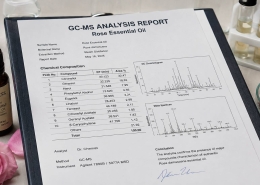
GC-MS analysis can help identify and characterize many of these constituents and provides an important analytical tool for evaluating an essential oil.
For Rosa Damascena essential oil, compounds such as citronellol, geraniol and nerol are among the constituents commonly discussed in analytical studies.
However, buyers should avoid treating a single published chemical range as a universal specification for every Rose Otto.
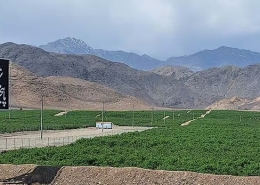
Natural materials vary according to factors such as botanical material, geographic origin, cultivation conditions, harvest and processing.
This is why batch-specific analytical data can be more useful for procurement and quality-control decisions than relying solely on generic literature values.
Documentation Is Becoming Part of Supplier Qualification
For professional cosmetic and fragrance buyers, documentation is increasingly part of the purchasing decision.
Depending on the intended application and market, buyers may request:
- GC-MS
- COA
- TDS
- SDS/MSDS
- Allergen Declaration
- IFRA-related documentation where applicable
- Botanical information
- Batch information
The purpose is not simply to collect paperwork.
Documentation allows technical, quality and procurement teams to evaluate the ingredient before incorporating it into a commercial formulation.
EU Fragrance Allergen Labelling: Why Buyers Should Pay Attention
European regulation has increased the importance of fragrance allergen information.
Regulation (EU) 2023/1545 introduced expanded fragrance allergen labelling requirements under the EU Cosmetics Regulation.
The European Commission states that cosmetic products placed on the EU market before 31 July 2026 can continue to be made available until 31 July 2028, subject to the regulation’s conditions. Products newly placed on the market after the relevant deadline need to meet the updated requirements.
For ingredient buyers, this highlights an important point:
The supplier’s technical information can affect the work of the formulation and regulatory teams downstream.
A supplier who can provide clear and relevant technical information makes the qualification process easier.
What About IFRA?
IFRA Standards are an important part of fragrance-industry safety and product stewardship.
The current published IFRA Standards documentation includes the 51st Amendment. IFRA also launched a public consultation for the proposed 52nd Amendment in December 2025, with the consultation running until June 2026.
It is important, however, to distinguish between IFRA Standards and legal requirements.
IFRA explains that its Standards are part of a voluntary product stewardship program and that compliance with IFRA Standards alone may not be sufficient to establish full regulatory compliance in every market.
For buyers, the practical lesson is simple:
Do not ask only whether a supplier has “IFRA”.
Ask what documentation is available for the specific material and intended application.
Traceability Is Becoming More Important
Natural ingredients have an inherent supply-chain challenge.
The final material depends on biological raw materials that can vary with:
- Climate
- Harvest conditions
- Botanical source
- Processing
- Storage
For this reason, traceability and batch identification are valuable parts of professional quality systems.
IFRA’s good operating practice guidance also emphasizes batch identification, records, testing and quality-control procedures for fragrance ingredients.
For buyers, this means that a supplier’s ability to identify and document batches can be just as important as the initial sample.
What Should a Cosmetic Ingredient Buyer Ask a Supplier?
Before approving a new natural fragrance ingredient, a buyer can start with a simple checklist:
- What is the exact botanical identity?
- What extraction method is used?
- Is batch-specific analytical data available?
- Can the supplier provide a COA?
- Is SDS/MSDS available?
- Is an Allergen Declaration available?
- Is relevant IFRA documentation available?
- How is the material stored?
- How is each batch identified?
- Can the supplier support repeat commercial orders?
These questions do not guarantee quality.
But they create a much stronger starting point for supplier qualification.
What This Means for Rose Otto Buyers
Rose Otto is a particularly interesting example.
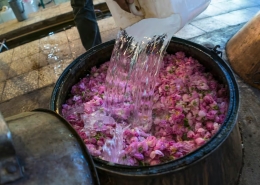
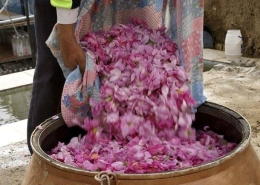
It is a high-value natural fragrance ingredient with a complex botanical origin and a very low yield compared with the amount of fresh floral material required.
For buyers, this makes supplier qualification especially important.
The purchasing decision should consider more than price per kilogram.
A professional evaluation should look at:
- Botanical identity
- Extraction method
- Analytical profile
- Sensory profile
- Documentation
- Batch consistency
- Supply capability
The objective is not simply to find the cheapest Rose Otto.
It is to find a material that is appropriate for the intended formulation and a supplier capable of supporting the business over time.
The Future of Natural Fragrance Sourcing
The natural fragrance market is developing at the intersection of three forces:
Consumer demand for natural and sensorial products
Increasing technical and regulatory expectations
The need for reliable global supply chains
For suppliers, this means that product quality alone is no longer the entire proposition.
Transparency, documentation and technical communication are becoming part of the value of the ingredient itself.
For buyers, it means that supplier qualification should begin before the purchase order — not after the material arrives.
Conclusion
Natural fragrance ingredients continue to offer significant opportunities for cosmetic and fragrance companies.
But the professional sourcing process is becoming more sophisticated.
The most valuable supplier is not necessarily the one offering the lowest price.
It is the supplier that can combine:
- Consistent quality
- Reliable analytical information
- Technical documentation
- Traceability
- Supply reliability
- Clear communication
At Zariness, our focus is Premium Damask Rose Essential Oil for professional fragrance, cosmetic and aromatherapy applications.
We believe the first step in a successful supplier relationship is not the purchase order.
It is the ability to evaluate the ingredient with confidence.
For technical documentation and professional inquiries:
zariness.ir





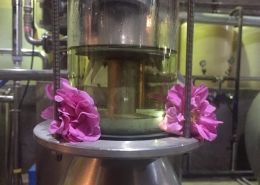
 Fresh Rosa Damascena
